

Your business has a billing system. Your invoices are generated digitally. Your subscription data is organized, and your finance team has established processes.
So why are invoices still delayed? Why do payment follow-ups get missed? And why does your team spend hours resolving billing discrepancies instead of focusing on more strategic financial work? This happens when billing becomes an operational challenge.
For many B2B and SaaS companies, the problem isn’t necessarily their billing software. It’s the operational work required to keep the entire billing process running smoothly.
From managing recurring invoices to tracking overdue payments, reconciling transactions, and resolving billing exceptions, these responsibilities demand time, consistency, and attention to detail.
As a business grows, managing these tasks internally can become increasingly challenging.
This is where managed billing services offer a practical alternative. Instead of replacing your existing systems or adding another software platform, you can bring in skilled billing professionals to manage the day-to-day operations within the systems your business already uses.
What Are Managed Billing Services?
Managed billing services involve outsourcing billing operations to a dedicated team of professionals who handle defined billing responsibilities on behalf of your business.
Unlike billing software, which provides tools to automate or organize billing activities, managed billing services focus on the people and processes required to execute those activities.
Depending on your business requirements, these services can include:
- Invoice preparation, processing, and delivery
- Recurring and subscription billing management
- Usage-based billing support
- Accounts receivable monitoring
- Payment reminders and overdue invoice follow-ups
- Failed-payment monitoring and recovery coordination
- Transaction reconciliation and discrepancy resolution
- Billing exception management and reporting

The objective is straightforward: keep billing operations organized, consistent, and aligned with your business processes without requiring your internal team to manage every task themselves.
For US-based B2B and SaaS businesses, this approach can provide additional operational capacity while allowing the company to continue using its established billing systems.
Why Billing Operations Become More Difficult as Businesses Grow
Billing often appears manageable when a business has a limited number of customers and invoices. However, growth introduces more transactions, more exceptions, and more opportunities for operational gaps.
1. Recurring Billing Requires Consistent Oversight
SaaS companies frequently rely on recurring revenue from monthly or annual subscriptions. B2B companies may also operate under recurring contracts, retainers, or usage-based pricing arrangements.
Each billing cycle creates operational responsibilities. Customer information must be accurate, billing terms must be followed, invoices must be processed on schedule, and changes to subscriptions or contracts must be reflected correctly.
When these activities depend entirely on an already busy internal team, inconsistencies can occur.
Managed billing professionals can help oversee these recurring tasks, monitor billing exceptions, and maintain consistency across billing cycles.
2. Sending an Invoice Doesn't Guarantee Payment
Generating and sending an invoice is only one stage of the billing process.
Businesses must also monitor payment due dates, identify overdue accounts, follow up with customers, and track outstanding balances.
When payment follow-ups are delayed or inconsistent, invoices may remain outstanding longer than necessary.
A managed billing team can support accounts receivable operations by monitoring open invoices, coordinating payment reminders, documenting follow-ups, and escalating unresolved issues according to agreed procedures.
This gives businesses better visibility into outstanding receivables and helps ensure that payment-related tasks receive consistent attention.
3. Billing Exceptions Consume Valuable Time
Not every billing transaction follows a straightforward path.
A customer may question an invoice. A subscription change may not match the expected billing amount. A payment may fail, or a reconciliation may reveal a discrepancy.
These situations require investigation, communication, documentation, and follow-through.
Without clear ownership, billing exceptions can remain unresolved while team members prioritize other responsibilities.
Managed billing professionals can help track these exceptions, coordinate resolutions, maintain records, and escalate issues that require approval or intervention from your internal team.
4. Growing Workloads Don't Always Justify a Larger Internal Team
Hiring additional finance staff can help a growing company manage its workload. However, businesses may need additional operational support before they are ready to expand their permanent headcount.
Managed billing services provide another option: assigning defined billing responsibilities to skilled professionals without making every additional task the responsibility of existing employees.
This can help businesses distribute operational workloads more effectively while retaining internal oversight of financial decisions and business policies.
Managed Billing Services vs. Billing Software: What's the Difference?
Billing software and managed billing services serve different purposes. Understanding the distinction helps businesses identify what they actually need.
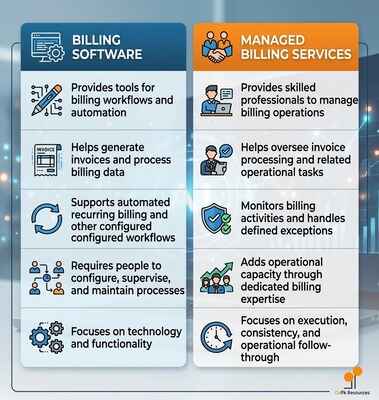
These options are not mutually exclusive. In fact, managed billing services can complement existing billing software.
A company may already have the technology it needs but lack the time, staffing, or dedicated expertise to manage the associated workflows consistently.
In that situation, purchasing another platform may not address the underlying problem. Additional operational support may be the more relevant solution.
Do Managed Billing Services Require New Software or System Integration?
Not necessarily.
Businesses sometimes assume that improving their billing operations requires implementing a new platform, migrating financial data, or introducing additional integrations.
However, a managed billing arrangement can work differently.
A service provider’s team can operate within the client’s existing billing environment, subject to the agreed scope of work, system capabilities, and authorized access.
This allows the business to retain its current tools and established workflows while delegating selected operational responsibilities to experienced professionals.
At GoPK Resources, the focus is on managing billing operations using the systems your business already has in place—not selling a proprietary billing platform or making new software integration the centerpiece of the service.
The emphasis is on the operational work itself: processing invoices, monitoring billing activity, following up on outstanding payments, tracking discrepancies, and maintaining visibility into the billing process.
The specific responsibilities are determined by your business requirements and the systems you use.
What Does a Managed Billing Service Provider Handle?
The scope of managed billing services varies by provider and client requirements. For B2B and SaaS companies, the following responsibilities are common areas of operational support.
Invoice Processing and Management
Invoices need to reflect the correct billing terms, amounts, customer details, and payment deadlines.
A managed billing team can support invoice preparation, processing, delivery, status monitoring, and exception tracking in line with established procedures.
Recurring and Subscription Billing
Subscription changes, renewals, recurring charges, and billing-cycle schedules require ongoing attention.
Billing professionals can help monitor these activities, identify inconsistencies, and ensure that exceptions are addressed through the appropriate process.
Accounts Receivable and Payment Follow-Ups
Outstanding invoices need to be tracked, and payment follow-ups need to happen consistently.
Managed billing support can include monitoring receivables, sending or coordinating reminders, documenting customer responses, and escalating overdue accounts according to agreed guidelines.
Failed-Payment and Billing Exception Management
Failed payments and billing discrepancies can disrupt normal operations if they are not addressed promptly.
A managed billing team can monitor relevant exceptions, coordinate follow-up actions, document outcomes, and escalate cases requiring technical, financial, or customer-service intervention.
Reconciliation and Reporting Support
Billing records and payment information need to be reviewed for discrepancies and incomplete transactions.
Depending on the agreed scope, billing professionals can assist with reconciliation activities, exception reporting, transaction tracking, and operational summaries that help internal teams understand the status of billing activities.
How to Know Whether Your Business Needs Managed Billing Services
Managed billing services may be worth considering if your business experiences any of the following challenges:
- Your finance team spends too much time processing invoices and managing recurring billing tasks.
- Payment reminders and accounts receivable follow-ups are inconsistent.
- Billing discrepancies frequently require manual investigation.
- Your subscription or contract volume is growing faster than your team’s capacity.
- Outstanding invoices are difficult to monitor across customers and billing cycles.
- Your business has functional billing software but lacks sufficient people to manage its daily operations.
- You want additional billing support without replacing your existing systems.
Not every business needs an outsourced billing team. If your current processes are efficient, your workload is manageable, and your team has sufficient capacity, additional support may not be necessary.
However, when operational gaps begin affecting consistency, visibility, or staff capacity, managed billing services can provide a structured way to address those challenges.
Why Consider GoPK Resources for Managed Billing Services?
At GoPK Resources, managed billing services are centered on a simple principle: businesses should be able to improve their billing operations without automatically adding more technology to their existing environment.
Our approach focuses on providing skilled professionals who support billing workflows within your existing systems, based on your requirements and agreed responsibilities.
Rather than asking you to adopt a new billing platform, we focus on helping manage the operational tasks that keep your billing process moving.
This can include invoice processing, recurring billing support, accounts receivable monitoring, payment follow-ups, billing exception tracking, and other agreed billing activities.
The goal is to help your internal team reduce the burden of routine billing administration while maintaining appropriate visibility and oversight.
For B2B and SaaS businesses, this creates an opportunity to add operational support without making a software replacement the starting point.
Every business has different billing requirements. The appropriate scope of support depends on your workflows, transaction volume, existing systems, and internal processes.